BOOKS BY STEPHEN BRAY
Each book is a different doorway into the same conversation.
The one about what happens when things stop working the way they used to.
Some books are manuals.
Mine are mirrors.
They don’t promise a neat fix. They invite you to look again: at timing, at patterns, at the quiet forces shaping your choices.
Each one comes from decades spent with founders, families, and leaders facing turning points they couldn’t name, but couldn’t ignore.

Photography and Zen: Discovering your true nature through photography.
Professor Michael Eldridge, former Head of Post Graduate Studies in Photography at 'The Arts University' states in the Foreword:
"Stephen Bray writes here a travelogue about his voyage and search for meaning and inspiration. He also explores the relationship between photography and awareness within the context for formal Buddhist philosophy, for the benefit of those wishing to understand how these may be linked. Then, in Part Two, he shares his own experience and sets out some exercises for you to explore."
"He gets lost, gets confounded in dead ends, is led and misled by people he comes across (it seems always by chance or perhaps by destiny) but they don't disappoint him as he knows he is learning from them; always open to new experience and always learning. There is one constant, his camera. It is not just one cherished item. It is a generic camera, an extension of his mind which somehow projects itself through his eye and then through the lens out into the so called world of reality."
[Read: A Snippet →]
Ho'oponopono: What is it? Can it help? What are its limits?
Deep within every individual resides an infinite wellspring of wisdom and peace, often overshadowed by the noise of our external world. Ho'oponopono, an ancient Hawaiian practice of reconciliation and forgiveness, presents an intriguing key to unlocking this vast reservoir of self-knowledge.
"But what are its limits?" you may ask. This question lies at the crux of this masterful exploration, compelling readers to question and reassess the boundaries of their potential. Here, you'll find that Ho'oponopono isn't merely a technique. It's a transformational mindset that allows you to manifest a life of purpose and joy.
[Read: A Snippet →]
Deep Ho'oponopono:
What makes Ho'oponopono unique and why it's different from the
Laws of Attraction.
Deep Ho’oponopono treats ho’oponopono as a return, not a reward system. It speaks to the reader who arrived exhausted rather than ambitious, the person who no longer trusts willpower, affirmations, or “high-vibration” performance. This book keeps what endures in the practice and lets fashion fall away.
Many modern teachings turn ho’oponopono into a vending machine. Chant for money. Clean for a car. Repeat phrases as if repetition equals wisdom. Deep Ho’oponopono draws a boundary. The only “manifestation” that matters here involves a return to Zero, with a reduction of unnecessary suffering along the way. That aim does not shrink life. It clarifies it.
You will not find a catalogue of add-ons and gimmicks. You will find preparation, timing, and the deeper logic beneath the phrases. The book shows how goals fail when an old inner model quietly disagrees, how the nervous system defaults to what feels true, and how repeating loops can function as an invitation rather than a trap. It brings the mirror principle back into focus, not as blame, but as recognition. It explores attention, rebirth, and recursion in plain terms, then moves toward breath, science, and the idea of cleaning as a world-making act.
[Read: A Snippet →]
A Simple Guide To Ho'oponopono
A practical introduction for people who
want to begin.
A Simple Guide to Ho'oponopono offers a clear and practical introduction to a gentle inner practice that can help life feel lighter, calmer, and less crowded.
Many people live with repeating reactions, old fears, emotional habits, and a sense that the same problems keep returning in different forms. They may blame the world outside, or blame themselves, without seeing that much of their suffering comes from what keeps rising within. This short book introduces ho'oponopono as a simple way of beginning to clear that inner clutter.
Written in straightforward language for adults who prefer clarity over theory, this book explains the practice in a calm and accessible way. It does not assume prior knowledge. It does not ask the reader to master a complex spiritual system before they begin. It starts where most people actually live: stress, hurt, confusion, repeated patterns, inner noise, and the wish for more peace.
Drawing on more than fifty years of work as a social worker, psychotherapist, and business mentor, Stephen Bray writes from long experience of helping people understand themselves more deeply and suffer less. Over time, that work led him towards ho'oponopono, not as a fashionable slogan, but as a practice that he found effective from every serious angle he knew how to examine.
[Read: A Snippet →]
The Rythm Is Always There: Move With Time, Go With The Tide.
Most people try to fight the tide.
They cling to old strategies, old identities, and old systems—long after the rhythm has shifted.
They build as if success is static.
They panic as if failure is final.
Inside, you’ll discover:
The hidden cycles that govern markets, relationships, and revolutions—and how to read their early signs.
How real leaders, from small business owners to global thinkers, adapt when the tide turns.
Why resilience means preparing for winter while harvesting the rewards of spring.
What failing well really looks like—and how to begin again without bitterness.
How to move with humility at the peak and with courage at the bottom.
When to invest. When to downsize. When to rest. When to rise.
For business owners, strategic thinkers, advisors, and anyone carrying large responsibilities, this book offers no formulas. But it does offer a compass.
[Read: A Snippet →]
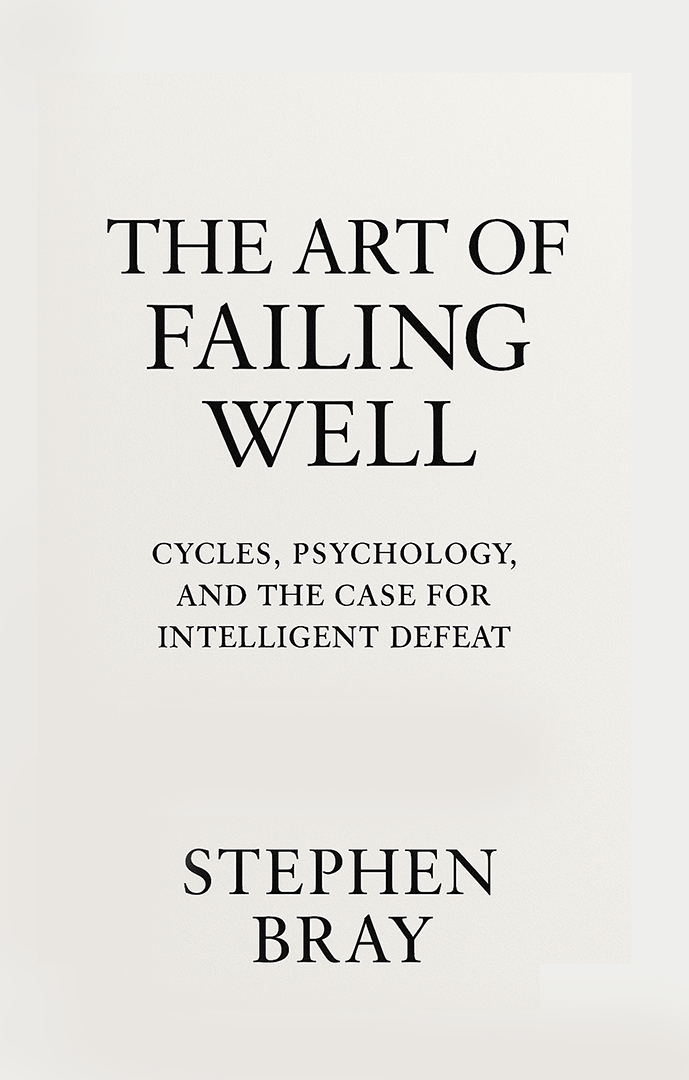
The Art Of Failing Well: Cycles, Psychology, And The Case For Intelligent Defeat.
This is not a book about how to avoid failure.
It’s about how to fail wisely and what happens when you don’t.
Drawing on psychology, systems thinking, and historical pattern recognition, The Art of Failing Well explores how even the smartest people fall and how some turn those falls into foundations.
The book reveals what failure really teaches, when it’s strategic, and when it’s simply the cost of staying in the game. For the thoughtful reader in turbulent times, this is a companion for the long road back.
[Read: A Snippet →]
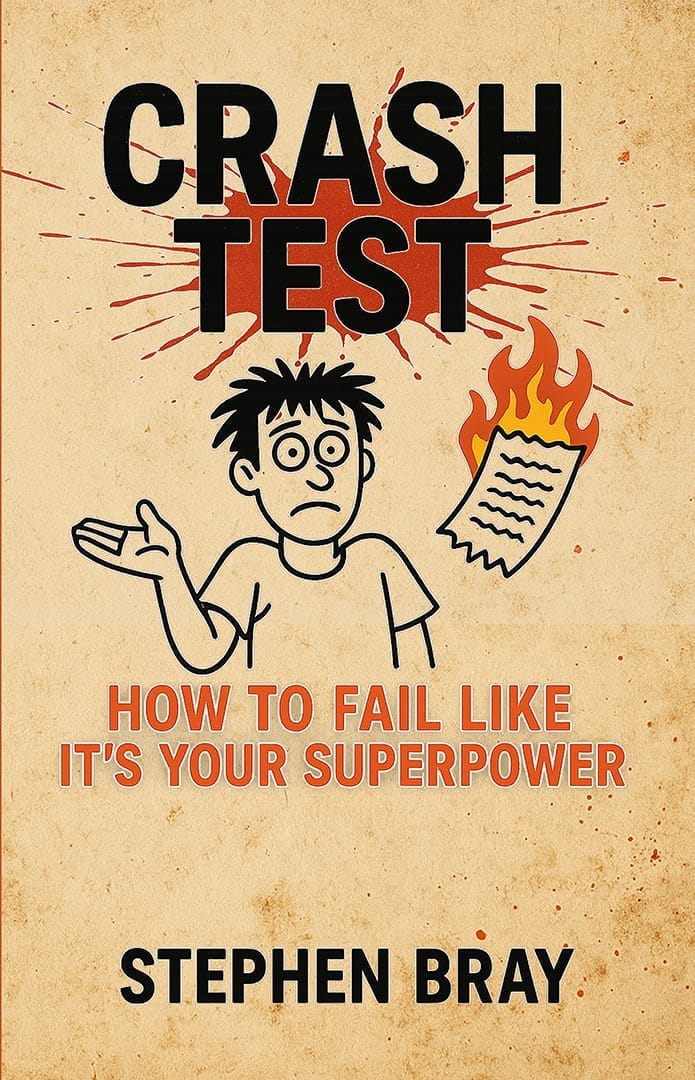
Crash Test: How To Fail Like It's Your Superpower
Crash Test is a brutally honest, darkly funny book about what happens when your life doesn’t collapse all at once—but quietly buckles under pressure. No bounce-backs. No five-step plans. Just the anatomy of failure told in short, punchy chapters that read like survival notes found in a glove compartment after the crash.
Whether you're recovering from a job loss, a creative burnout, a nervous breakdown in a toilet cubicle or just the slow erosion of ambition in a polite Zoom call,this book will remind you that you're not alone.
You don’t need a new blueprint.
You just need to start where you are.
Preferably with the truth—and possibly one shoe missing.
[Read: A Snippet →]
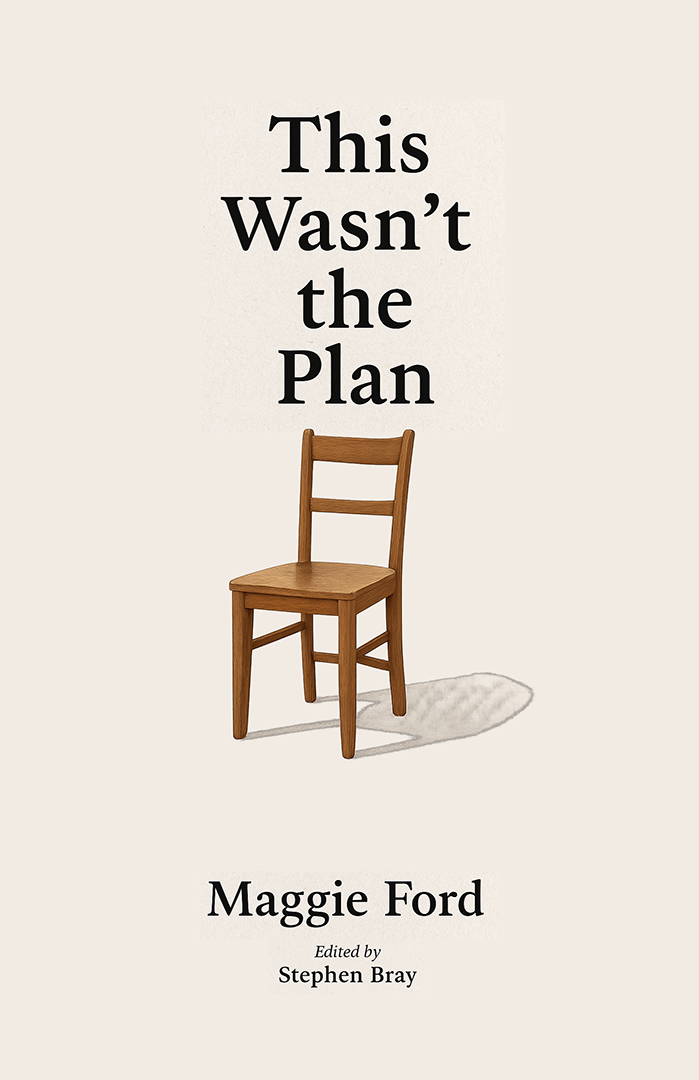
This Wasn't The Plan: On Pressure, Disappearance, and Not Going Back
No, I didn't write this book. I just lightly edited it.
What happens when you stop being nice? You start being honest.
Maggie Ford thought she was just leaving a job.
Instead, she walked away from a version of herself: agreeable, bendable, useful — and quietly breaking.
This Wasn’t the Plan is a fierce, unsentimental portrait of what happens when women refuse to disappear. In tightly drawn entries, sharp, spare, and darkly funny. Maggie unpacks workplace burnout, quiet rage, unexpected friendship, and the slow reclamation of a self she barely recognised.
She doesn’t crash.
She doesn’t triumph.
She just leaves — and keeps going.
[Read: A Snippet →]
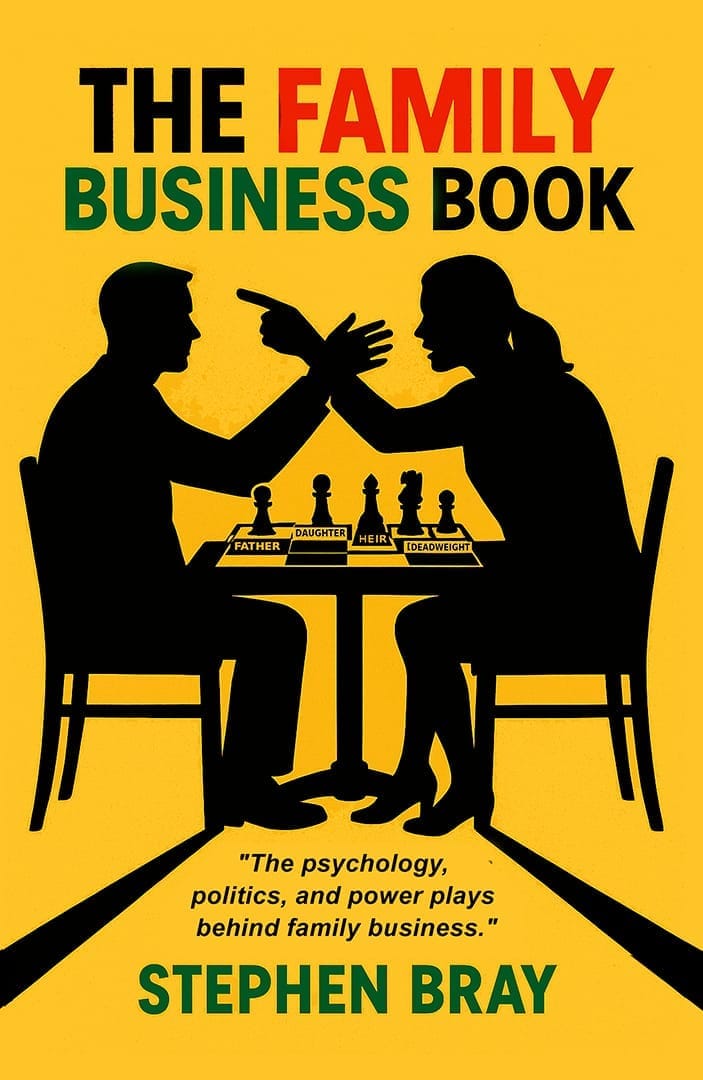
The Family Business Book: A twelve-step guide to surviving succession, power struggles, and staying sane.
Third Edition: Fully Updated for the Post-COVID and AI Era
Every business starts with a family.
Even the largest companies began with a founder, a kitchen table, and a dream.
But what happens when that family grows? When the children come of age—or refuse to? When power shifts from one generation to the next, often without a plan?
In this newly updated edition, The Family Business Book offers a practical and psychologically informed roadmap for navigating the emotional complexity of family-run enterprises. Whether you're planning a succession, stuck in a silent standoff between siblings, or wondering how artificial intelligence and post-COVID realities are changing what leadership looks like, this book helps you find clarity.
Built around twelve practical steps, it combines real-world business insights with a rare understanding of human dynamics. You’ll learn how to lead without dominating, how to prepare heirs without stifling them, and how to keep both the company and the family alive.
[Read: A Snippet →]
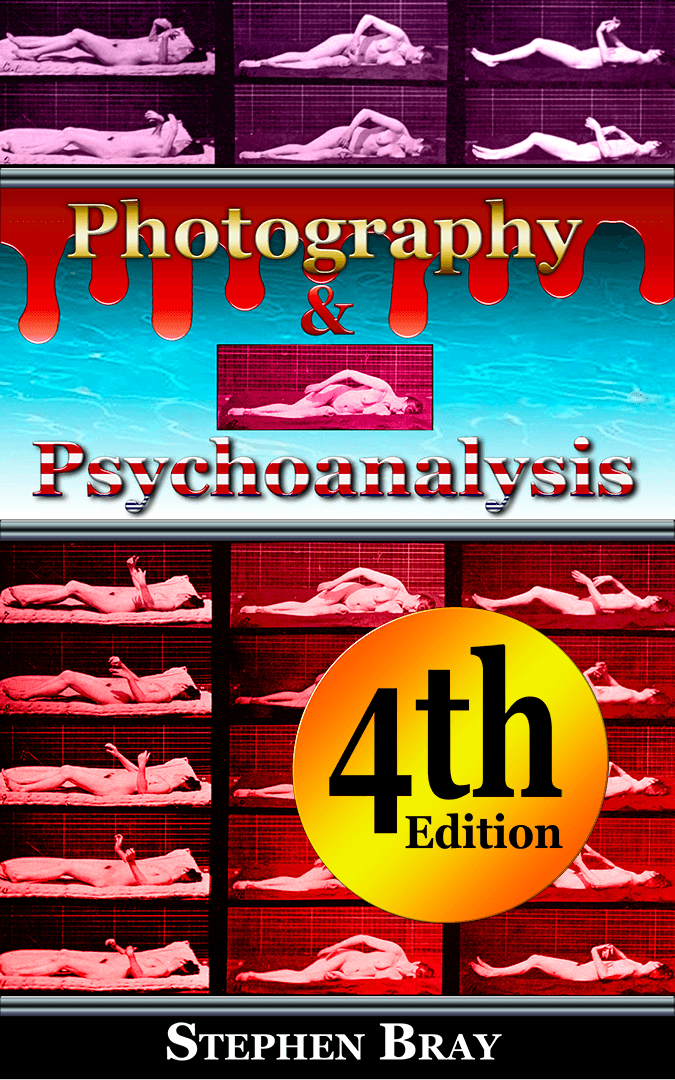
Photography and Psychoanalysis: The Development of Emotional Persuasion in Image Making.
A gem of a book" - Michael Eldridge, Former Head of Post Graduate Studies in Photography.
"Intelligent and contentious" - Dr. Julian Stern, Psychiatrist and Psychotherapist.
"Shows how fears and dreams can be exploited" - Scott Lucas, Professor of American History.
"Shocks and amazes by revealing the deep secrets of emotional persuasion" - Lilach Bullock, Forbes' Top 20 Women's Social Media Influencers.
This concise, illustrated, work informs about the histories of photography and psychoanalysis. It describes how they came together in the 20th Century to revolutionize political propaganda and sales messages. It references the works of several 20th Century and contemporary photographers including: Edward Steichen, Brian Duffy, Helmut Newton, Henri Cartier-Bresson, Nan Goldin, Gregory Crewdson, Larry Clark, and Wang Qingsong.
This FOURTH EDITION summarizes and critiques many of the thoughts of the philosopher and activist Susan Sontag. It also analyses the photographic basis in the Works of Andy Warhol, and why his artwork is important to photographers, and those wishing to understand commercial propoganda.
It demonstrates how images may be understood, and interpreted, using the ideas of Freud, Jung and Lacan. Written in simple language this isn't a work about how to make technically 'better' images, but rather a book to help you understand the psychological impact of images.
[Read: A Snippet →]