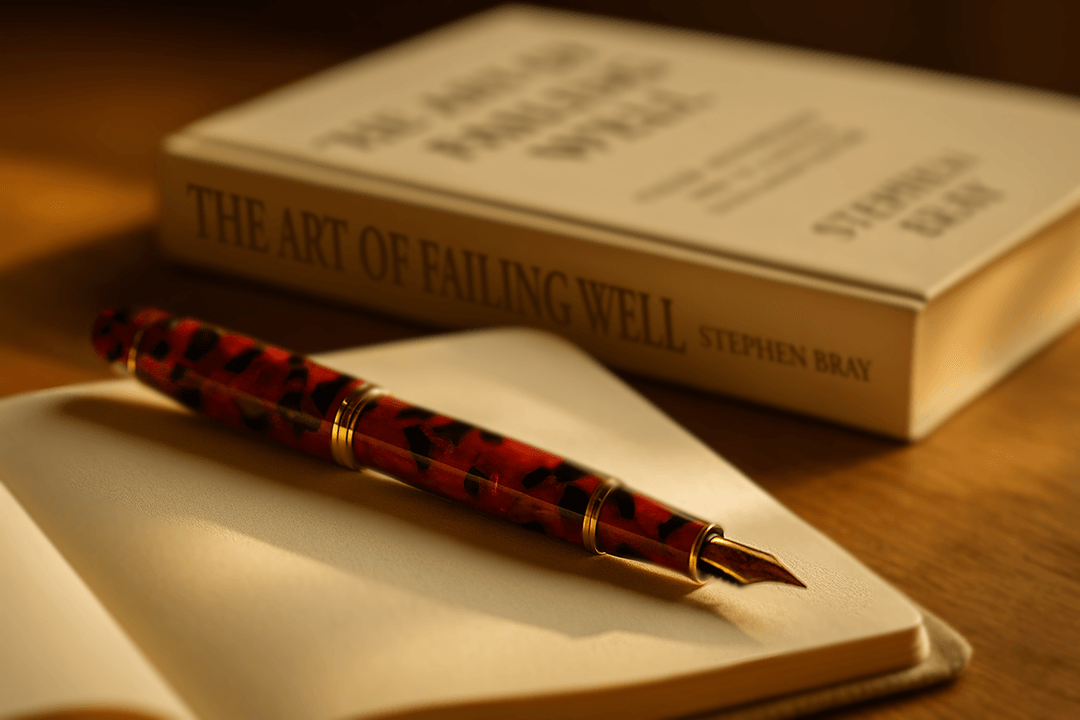
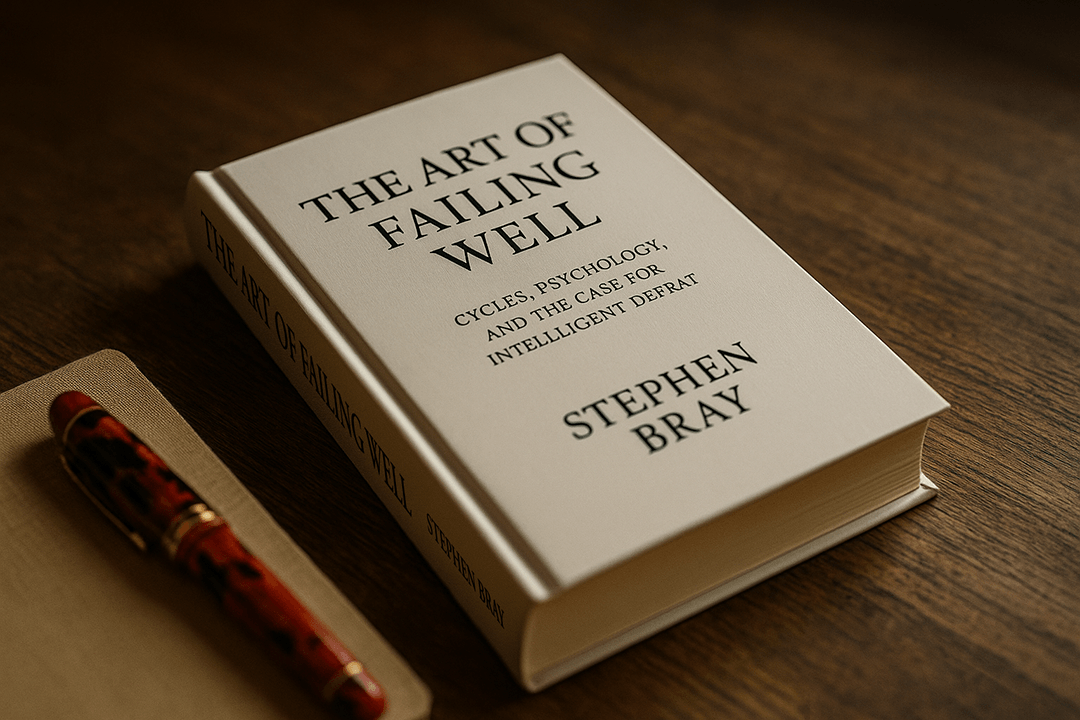
THE ART OF FAILING WELL
Cycles, Psychology And The Case For Intelligent Defeat.
This is not a book about how to avoid failure.
It’s about how to fail wisely and what happens when you don’t.
Drawing on psychology, systems thinking, and historical pattern recognition, The Art of Failing Well explores how even the smartest people fall and how some turn those falls into foundations.
From sunk cost traps and overconfidence to creative risk and the long arc of legacy, this book offers a taxonomy of failure that goes beyond platitudes. It reveals what failure really teaches, when it’s strategic, and when it’s simply the cost of staying in the game.
For the thoughtful reader in turbulent times, this is a companion for the long road back.
Inside The Book
The Cycles That Set Us Up
The sea looks calm.
But the yacht's keel is whispering something else. You can’t see it—not yet—but the pressure’s changed. Wind in the wrong direction. The crew is nervous but saying nothing. They think it's them. It isn’t.
And that’s how most failures start.
Not with a bang, but with a swell. Not with incompetence, but with bad timing—so big and slow you can’t even see it until it’s curled up under your foundations.
You think you made a mistake. Maybe you did. But maybe the wave was already moving.
History is full of people who rowed against it.
Wiser, sharper, stronger—and still drowned.
Gallienus. Xerox PARC. Herbert Hoover. You.
Somewhere, on the Internet, someone is saying failure is a gift. That’s true.
But only if you understand what failed.
You? Or your timing?
Before we go anywhere else in this book, we need to talk about what you're actually standing on. Because most people think they’re walking on ground.
They’re not.
They’re surfing.
And no one tells you the tide’s gone out until you’re lying in the sand, bleeding from the coral.
Nikolai Kondratiev didn’t die at a conference.
He died in a Soviet prison camp, shot in the back of the head for telling the truth about cycles.
In the 1920s, he noticed something that most economists ignored: the economy didn’t just bounce up and down, it moved in long, sweeping waves. Fifty-year arcs. Booms. Stagnation. Collapse. Then something new. Not random. Not rational. Rhythmic.
He called them long waves—and if you’re the sort who likes tidy metaphors, he even gave you seasons:
Spring (boom), Summer (inflation), Autumn (decay), Winter (depression).
The only problem? You don’t get to choose which one you’re born into.
Take the man who starts a business in 1948. He gets cheap credit, eager customers, and a tidal wave of optimism. Now take the same man in 1973—interest rates spike, the oil stops flowing, and the party's over before it begins. Same brains. Same idea. Different wave.
That’s not failure. That’s seasonality.
And you don’t argue with the weather.
Historians William Strauss and Neil Howe saw something similar, but through a different lens. Generations, not GDP.
Every 80 to 90 years, they said, societies go through a full turn of the wheel:
High → Awakening → Unravelling → Crisis.
Like quarters in a long game nobody’s winning.
You’re not just born in a year, you’re born in a turning³.
Boomers inherited the High. Gen X hit the Unravelling. Millennials, bless them, graduated into the Crisis.
And if you're unlucky enough to be holding the tiller during the Crisis? It doesn’t matter how good you are. You will be punished for what came before.
Ask Herbert Hoover.
He took office in 1929, armed with brilliance, optimism, and an engineer’s belief in systems.
He never stood a chance.
The wave was already breaking.
Four years later, Hoover was out and Roosevelt walked in like Poseidon in pinstripes. But it wasn’t magic. It was the same wave, shifting phase. Winter turning to Spring.
Why I Wrote This Book
Although The Art of Failing Well opens as the first in a three-part voyage, my attention had long rested on a quiet discomfort: watching people fall in business when every tool, model, and insight suggested they might succeed. I had refined interventions with psychology, structures, and systems. I had watched some flourish. Yet I had also watched others sink, despite the wind in their sails.
In truth, my own record held its own tides. While certain ventures reached safe harbour, others ran aground. Yet in the very moments where the charts showed wreckage, something unusual happened. A door I had not sought out appeared in my path. I had not designed it. I had not even imagined it. But there it stood, open, solid, and leading somewhere unexpected.
I wanted to write about that. About the rhythm that hides inside apparent collapse. About the way loss sometimes folds itself into opportunity, without warning and without our permission.
This book carries academic rigour, references, and care for accuracy. It does not lean on opinion, yet it cannot live within the strict bounds of a laboratory claim. It speaks of phenomena you cannot test the way you would test the chemistry of water.
It begins with failure, yet not in the way a court records it. Failure here acts as a teacher, a change in the wind, a shift in the current. Sometimes gentle, sometimes brutal, always altering the course.
You may recognise your own story somewhere in these pages. Not because the details match, but because the pattern does.
As an Amazon Associate I earn from qualifying purchases.