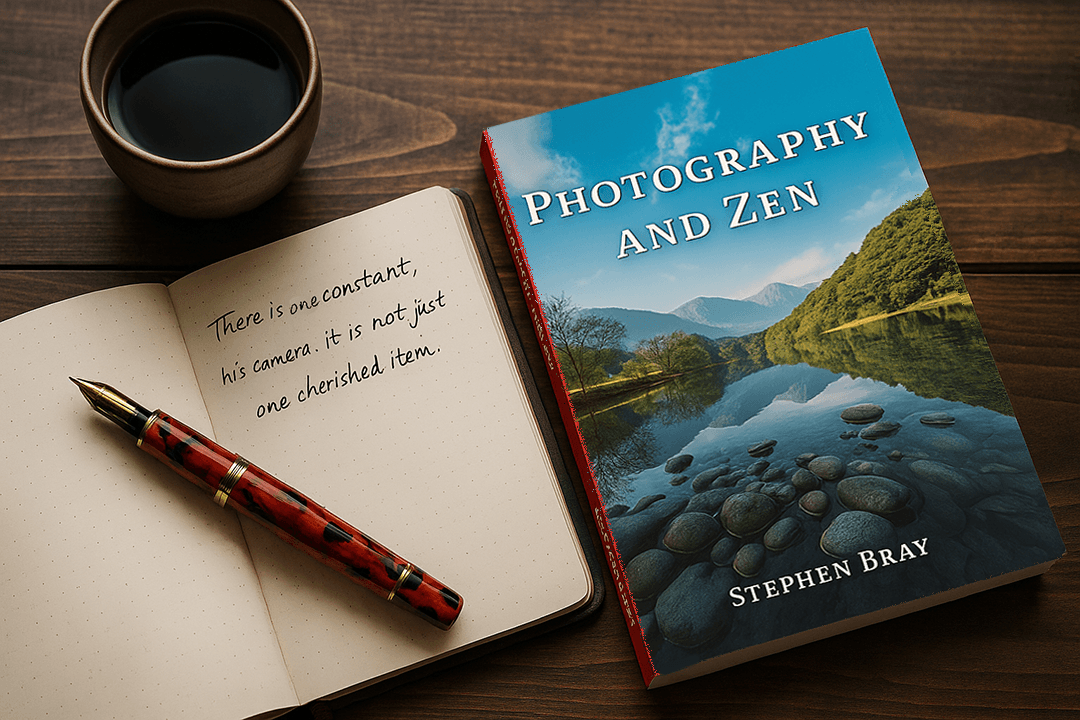
PHOTOGRAPHY & ZEN
Discovering Your Own True Nature Through Photography
Photography and Zen invites you to approach photography as a compassionate act, where self and world reflect one field. The first section examines the relationship between Zen practice and photography, uncovering both their resonant overlaps and their contradictions. Myths dissolve, leaving a clearer pattern beneath.
The second section moves inward, tracing the shift from observing the outer world to recognising the mind’s own architecture. Practical exercises, drawn from my own training, aim to unsettle familiar habits so new possibilities emerge.
Rather than teaching formulae, the book encourages you to photograph with simplicity, free from the noise of convention. Beauty can surface in the most overlooked places, and the image becomes a mirror for essential nature. By loosening the grip of conditioning, perception sharpens and vision renews. Technical skill follows naturally once seeing clears.
Inside The Book
A Philosophical Photographer And A Book
On June 6th, 1944 the Cubist painter Georges Braque (1882 - 1963) gave photographer Henri Cartier-Bresson (1908 - 2004) a copy of Eugen Herrigel's book 'Zen in the Art of Archery' (1948). It affected him deeply, and gave rise to perhaps the most philosophical quote in the history of photography.
"I believe that, through the act of living, the discovery of oneself is made concurrently with the discovery of the world around us, but which can also be affected by us. A balance must be established between the two worlds – the one inside of us and the one outside of us. As a result of a constant reciprocal process, both these worlds come to form a single one. And it is this world that we must communicate." Henri Cartier-Bresson - The Decisive Moment, 1952.
Zen is a form of Buddhism, which originated in India, changed as it passed through China arriving in Japan during the Kamakura (1185 - 1333) period, just as the Samurai class were coming to power. In the twentieth century it migrated again this time from Japan to France, into Europe, and also via the USA into Canada and other parts of the Americas.
This spreading across the globe has popularized the term Zen, but does not necessarily help you to discover your original essence. Today we find Zen snack bars, Zen Internet providers, Zen CMS systems, Zen clothing stores, Zen shopping carts, and a host of other products, which take advantage of the 'Zen brand', but have little, or nothing, to do with the core of Zen.
Some will tell you that Zen transcends any particular religious doctrine because it points to the deepest ground of life, a place acknowledged within all religions and long sought by scientists in the phenomenal world.
There is some merit to this view of Zen, for just as there are many different sects of Buddhism, so there are many different religions in the world, each with their mystical branches and methods. Buddhist teachings, however, differ from those of most other religions, which take God, or lesser gods, as starting points. Siddhartha Gautama (563 BCE to 483 BCE), commonly known as the Buddha (enlightened one) is said to have started as a human with two mortal parents, and remained a human being even after experiencing awakening.
Of course there are also folk stories about him, as there are concerning all avatars.
Buddhism may be regarded as much as a path of self-inquiry as a religion, indeed some people practice Buddhism and other religions concurrently and find no apparent discord. The religious leaders from most faiths, however, whilst acknowledging that Buddhism, particularly Zen, has a contemplative side as do their own belief systems, find it difficult to accept that one may at the same time be both Buddhist, and belong to their tradition of worship.
There is a natural affinity between Photography and Buddhism because both are concerned with revealing wider truth in the moment. Photography also has a darker side.
Many photographers take pride in arranging the light on their slides, prints and screens, in the service of illusions, which promise to satisfy our appetites but instead turn out to be temporary pleasures, such as pride in owning possessions such as expensive clothes, cars and cameras. This in turn inevitably leads us into loss, sorrow, and further emotional hunger. So it goes on until we find an alternative.
One of my teachers, a commercial photographer, said, "Photography is the art of lying with light." Can this be true?
It is, perhaps, for those photographers who seek to manipulate their images, and the subjects comprising them, in order to project specific messages. These are photographers with agendas.
In commercial photography such briefs are explicit and enforced by 'art' directors who work alongside the photographer.
In so called 'art photography' it's more complicated. Some photographers think that they're utterly transparent when making images, and so their pictures are objective recordings of scenes. If you have read the previous volume in this series, 'Photography and Psychoanalysis', you will know that this is rarely so.
Two processes are involved: firstly, the veiling of reality, and secondly the projection of what is thus created out into the world.
You stand in a landscape able to point your camera in any direction but are restricted in what you can include in the frame by your choice of lens. When you select the scene you will photograph you choose what will appear in the picture. When you print your image you give the subject you selected a second life through the way you interpret it for display. If others see your photograph they too may be affected by it, if only momentarily.
Your image, however, isn't the landscape itself, and, of course, it cannot be the totality of all possible scenes, past, present, and future. It doesn't even include the sounds you heard, the thoughts you had, or the taste in your mouth - yet it may be capable of getting past sensory based knowledge and introducing other possibilities.
When we introduce notions such as 'Zen' into photography it is exactly this totality, or non-duality, that we are discussing. The universe, the scene, including us - together with our internal psychological dispositions, our cameras, and subsequent audiences for our work all melt within the click of the shutter. What is recorded is not simply the thing itself, although an image is 'the image itself', but also a signpost pointing to something, a supra nothing, which transcends itself, you and me.
Zen has long had a place in such arts as calligraphy, painting, flower arranging, as well as Bushido - the Japanese martial arts.
It is because Zen practice seeks to awaken individuals to a totality that such arts may be considered a form of Buddhist practice. We neither truly wake, nor are awakened, via such methods, yet when we persist with open hearts and minds we are not simply promised glimpses of a new identity, which many expect, but instead arrive at the recognition of what was always hidden within the obvious.
Flower arranging and photography may not appear in the sutras about Siddhartha, but when practiced mindfully they represent alternative paths, which aren't in discord with the method it is claimed he left for us to follow. In the next few chapters we will explore if this is possible.

Why I Wrote This Book
Photography and Zen was meant to be the second part of a planned trilogy. The third keeps slipping beyond reach, perhaps because my later work already touches its territory — the shifting architecture of reality and the way perception reconfigures it.
Zen masters read change without clinging to it. They stand closer to the ground than the psychoanalysts I once studied, yet they notice the same undercurrents. One field moves through words and analysis, the other through silence and direct encounter. Both point toward the same principle: when inner and outer frequencies align, the moment resolves into clarity.
This book remains one of my most enduring works. It never asked for revision, and its core insight still holds: a photograph can mirror the coherence of a moment without embellishment.
These days, I often work with a gifted smartphone, proof that the essential act lies not in the tool but in the quality of attention.
You'll never take images with your smartphone in the same weay again!
As an Amazon Associate I earn from qualifying purchases.