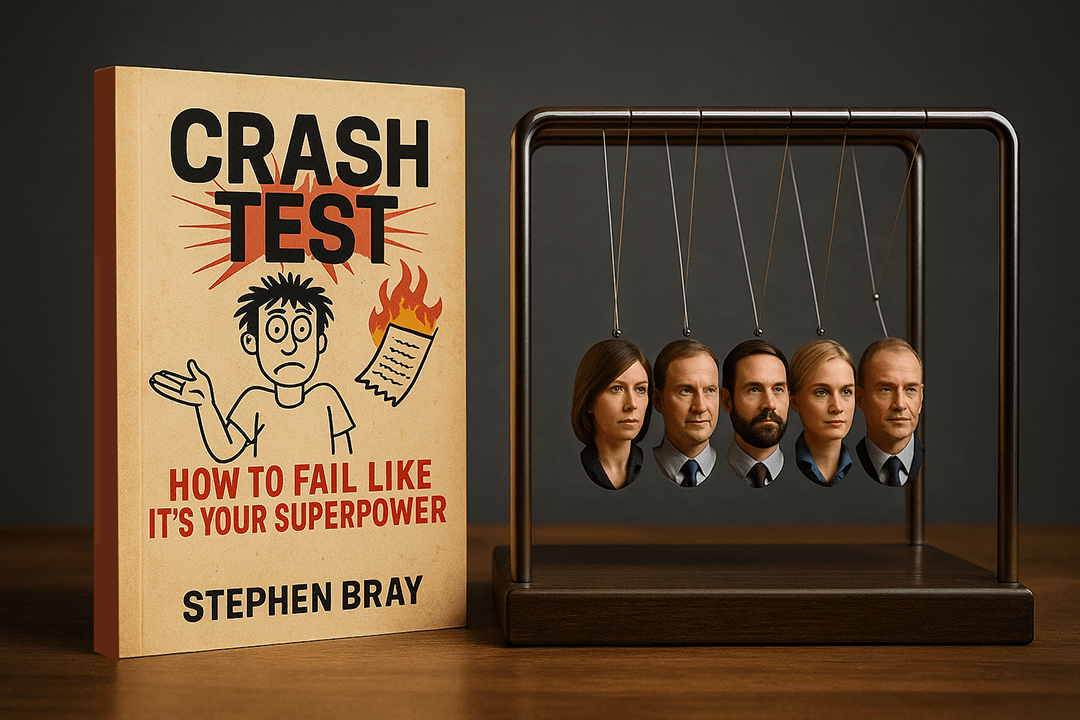
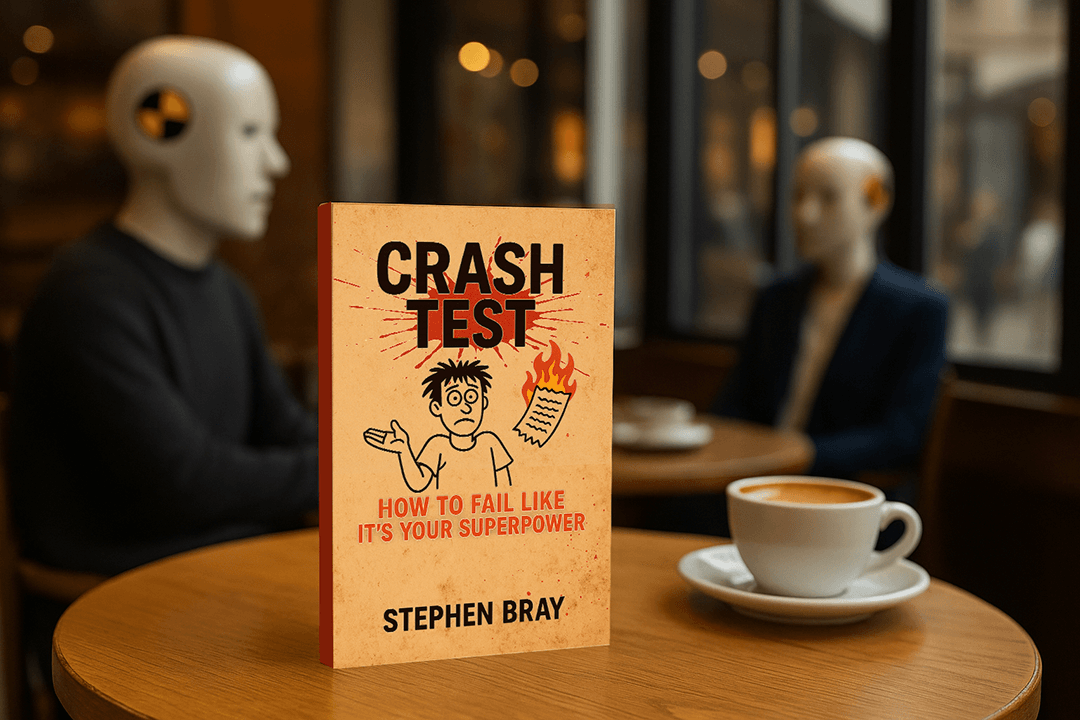
CRASH TEST
How To Fail Like It's Your Superpower
Crash Test opens like a head-on collision. The kind you don’t walk away from clean. It speaks with the dark precision of men who have lived through a slow, grinding drift into distortion, when the internal framework slips so far out of true that even the smallest pressure can shatter it.
Not the public implosions you can package into anecdotes, but the private buckling of a life out of harmonic balance.
It’s written for the high-functioning and hollowed-out. The founder who kept the suit but lost the signal. The overachiever running on echo. The consultant who can’t remember why they ever cared. You won’t find a redemption arc here.
Only the exact feel of breakdown in a misaligned field and the reminder that you can’t rebuild until you retune.
Inside The Book
YOU DON’T FALL WHEN THINGS ARE FALLING.
Failure Field Note #001 "It wasn’t the drink. Or the girl. It was that I believed my own pitch deck. That’s when I knew I was done."
That’s not how it works.
You fall in the stillness.
It’s the Tuesday morning when your inbox is finally empty. When the client says yes without a single question. When the rain clears up just long enough for the coffee queue to move faster than usual.
It’s the eerie hum of a life that looks like it’s working. And that’s when the crack begins to widen.
You don’t see it. Why would you? You’ve just been promoted. Your back pain's manageable. Your partner isn’t complaining. The kid’s stopped wetting the bed. Everything is… fine.
But there’s something about the smell of fine that should make your teeth itch. It’s not success. It’s the lull before the machinery fails. And you are the machinery.
I once knew a man who only cried in airport lounges.
He’d built his third business. Sold it. Sat on panels. Got flown to conferences to say things like "disruption is a mindset." He didn’t believe it, but it filled seats. One day, after delivering a keynote in Lisbon, he went to the bathroom, stared into the mirror above the sink and whispered, "I’m so tired of pretending to be this guy."
Then he got drunk and missed his flight.
He never told his wife. Just came home, kissed his kid, and spent the next five years googling the symptoms of burnout in incognito mode.
The fall had already started. But he hadn’t felt the landing yet.
That’s the trick. Falling doesn’t feel like falling at first. It feels like forward motion.
Because you’re still delivering. Still winning. Still clapped for.
You always smell it a little before it hits. But it’s easy to ignore—every time. Because recognising it means stopping. And stopping means thinking. And thinking means unravelling all the invisible tape holding your life together.
It’s easier to call it a busy month. A bit of low mood. Too much caffeine.
There’s a brief window where you could still change course. You could turn the wheel, slow the speed, re-aim the trajectory. But only if you admit the direction is wrong.
Nobody does.
Failure Field Note #002 "She said she loved me, but I looked better on paper. I didn’t even blame her. I wanted to leave me too."
Momentum is a kind of drug. Especially if you’re clever. Especially if people call you impressive.
Because then you start mistaking activity for agency. You’re doing things, sure. But are they your things? Or just the things that were handed to you at the last checkpoint?
People think failure is about weakness.
But often, it’s about strength misused. Smart people fall harder because they build their own blindfolds. They design custom armour, bespoke excuses, tailored narratives.
They wear their wounds like credentials. But the rot starts in the centre, and they don’t smell it until it leaks out onto the client call.
The slippery bit is when you still have time. But think you don’t need it.
You think the deal is going to land. You think your team has your back. You think the burnout will pass. You think the universe owes you a straight run after all you’ve done.
It doesn’t.
Nobody’s keeping track.
There’s no cosmic HR file with gold stars.
You’re coasting. And the scariest part? You look good doing it.
I remember once watching a guy drop a tray of espresso cups at an artisan café. He froze. Didn’t even try to catch them. Just watched them hit the floor in slow motion. Afterward, he said: "I’ve dropped them a hundred times in my head. Didn’t think it’d actually happen."
That’s how the fall feels. Inevitable. Familiar. And yet completely disarming.
Failure Field Note #003 "It started when I stopped writing music. Nobody noticed, including me. That’s how the soul goes: quietly."
You’ll think the clues weren’t there. But they were.
You stopped calling your brother. You delayed booking the check-up. You started lying about how many drinks. You found new ways to justify silence. And when your colleague failed, you smiled—just a little. Because at least it wasn’t you. Not yet.
This chapter isn’t about failure. It’s about the moment before.
The thin ice that looks like land. The smile that’s a little too wide. The Tuesday that feels like a gift until you realise the gift was a test.
And here’s the punchline:
By the time you realise you’re slipping, you’re already mid-air.
So what do you do?
Not much.
You stop trying to make the fall graceful. You stop pretending there’s a lesson in every bruise. You just brace. And you watch. And you make a little promise to yourself:
Next time—if there is a next time—you’ll learn to smell the rot earlier.
Or maybe not.
But at least you’ll remember this:
It wasn’t the storm that got you. It was the calm.
Why I Wrote This Book
Crash Test speaks in the kind of humour you earn after life’s hit you with the same brick so many times you start comparing the wrapping paper.
I had just finished The Art of Failing Well and The Rhythm is Always There. Both carry an academic tone, although The Rhythm is Always There still can’t decide whether it’s a textbook, a memoir, or a polite fever dream. After those, I noticed a strange gloss on my own voice. Too smooth. Too “nice”. Too much like the polished grins of people who insist the universe has a plan. So I wrote something jagged.
Crash Test fell out fast, probably because it came from lived experience — the kind where you blame someone else for a betrayal while privately knowing your own warped trajectory made the collision inevitable. It echoed the accounts I’ve heard from others on the road. People who, like me, carried a field so bent out of shape that it kept bending reality to match, over and over, until denial could no longer hold.
As an Amazon Associate I earn from qualifying purchases.