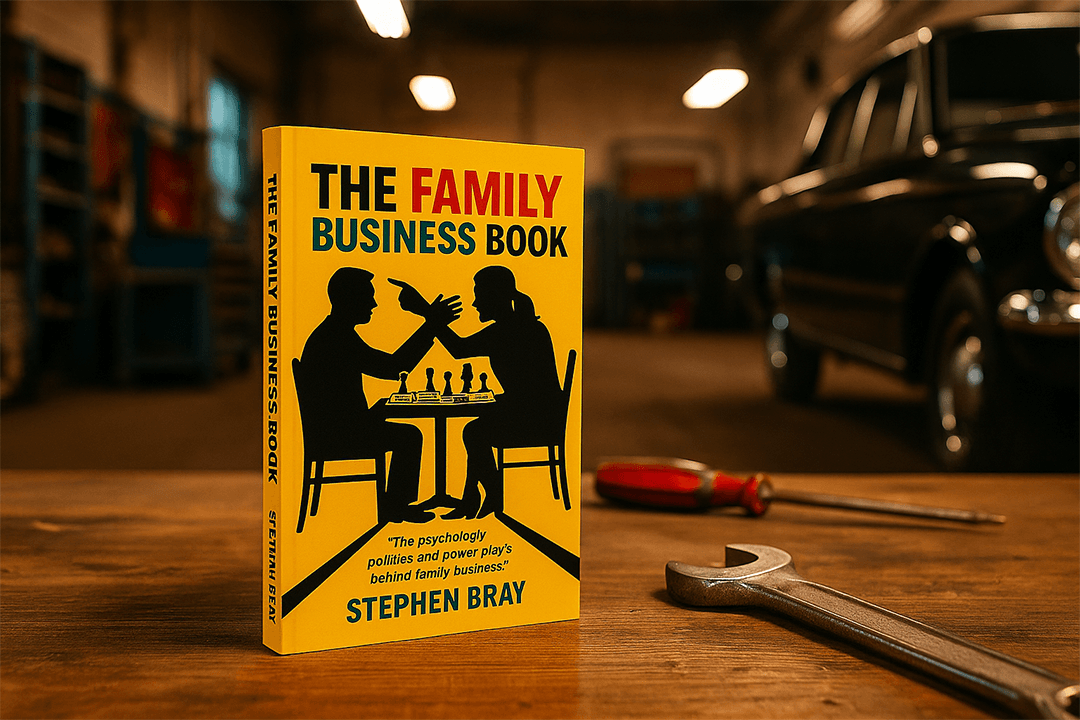
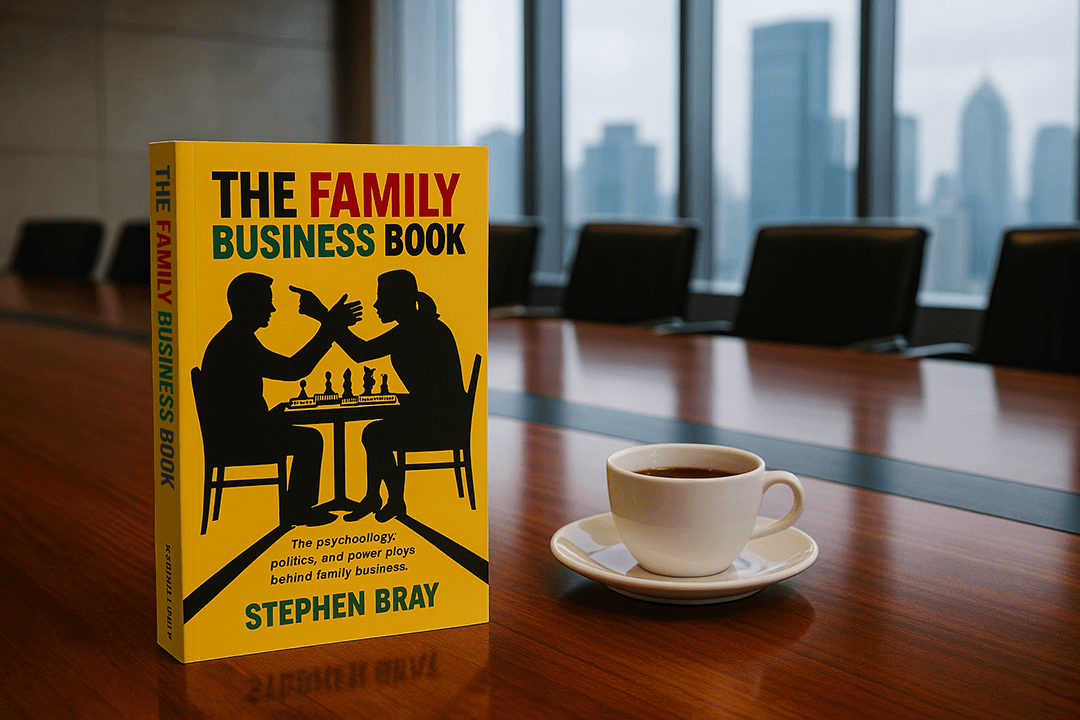
The Family Business Book
The psychology, politics, and power plays
behind family business.
Every family business carries a frequency.
It begins with a founding note, then shifts as heirs step forward, power changes hands, and the original tone risks distortion.
This third edition blends practical succession strategy with the deeper patterns that shape family-run enterprises. You’ll learn how to pass leadership without breaking the signal, prepare successors without muting their initiative, and adapt to AI-era realities without losing the legacy.
Treat your business as a living resonance structure. Align the tone, and growth carries itself. Let it drift, and the field resists until stability returns.
For founders, heirs, and those navigating the space between, this book offers a map for tuning legacy into its next, coherent key.
Inside The Book
Thinking about your Family Business?
If you ever feel like starting your own business (or perhaps reorganising one you’ve inherited) then understanding systems and how they relate to you through your family, suppliers, employees and customers will be crucial to your survival.
In most Western nations the average business startup fails within five years. Yet business touches all of our lives and most of us (even those who have failed a few times) yearn to start a new enterprise - either to change the world or to make a profit.
Businesses shape our world, be they the corner shops that provide a sense of community along with packages of oats and soap powder, or digital corporations through which we may order services and goods on-line and provide wholesalers with feedback via electronic forms.
For many years large corporations (such as Amazon and Apple) have enjoyed greater capital values than the Gross Domestic Products (GDP) of each of 183 out of the 199 countries (for which the World Bank holds GDP data).
Yet both of these were born in garages less than half a century ago.
Small wonder then that so many of us wonder if we may achieve something similar in our own lifetimes - only a very few do so.
Who makes a business? What sustains it?
For around forty years I’ve been running small businesses aimed at helping others. In this time I’ve been rubbing shoulders with some of the most experienced and thoughtful people in various fields - therapists, mentors, bankers, graphic designers, photographers, writers, philosophers - and more leaders and owners of small business than I care to list here.
Unfortunately so very few have clear ideas about the challenges we business owners face. Fewer know what it means to run a real business.
You cannot simply expect freedom to come overnight even when that’s your goal. Some business decisions are tough and may cause you (and others) emotional pain. You must face up to these if your business is to survive.
Business owners (thankfully) are rarely martinets. They are frequently sensitive souls who are passionate about their companies, concerned about their customers and workforces, and committed to delivering the very best products and services to the marketplace at reasonable cost.
A combination of these qualities is really essential to successful entrepreneurship.
Families tend to get drawn into businesses quite early in the process. Historically it was common for a man to start a small enterprise and when it began to flourish he would employ his wife who managed the office, acted as a personnel officer, as well as become the book-keeper.
Women are also business founders. Something approaching 200 million are starting or running new businesses in 74 economies around the world. Around 120 million women run established businesses. The number of women graduates in business is rising - although being a graduate isn’t necessary for starting (or succeeding) in business.
There are many ways of defining a business. A business that remains in the ownership of its founders, or the founder’s family is known as a ‘family business’. These enterprises bring with them their own peculiar challenges because the boundaries between working and family life are blurred.
A surprisingly small proportion of businesses survive the transition from first to second generation. Even fewer make it unscathed to the third generation. This has less to do with the idea (promoted in books such as The E-Myth) that you are best advised to systematise your business (with a view to selling it) from day one. It is more about the tensions that arise within families as the generations multiply.
Family Business is about investment rather than dividends. You cannot be successful unless you invest your time and a proportion of the profits back into your enterprise. This book will help you to get started, and sustain you as your business grows. It enables you to maintain a healthy balance between family life and work.
Each of us has the capacity to become a successful entrepreneur yet only a few of us will be brave enough to start and run our own business.
Maybe you’re one of the lucky few of sound mind and stout heart who has within you what is required.
If so this is the book for you.
Why I Wrote This Book
Today I write, and I mentor only a handful of people who meet the work with the right motivation.
I wrote this book for them, and for those who sense that the challenges in a family enterprise rarely live only in the balance sheet. It distils nearly fifty years of immersion in the field. While trends shift, and the language of business reinvents itself every decade, certain patterns of success and failure repeat with near-perfect fidelity.
You will find here timeless practices that still produce clarity and cohesion, alongside behaviours that almost guarantee breakdown. This edition also responds to the present landscape, where events both natural and engineered, from pandemics to AI-driven disruption, reshape how leadership feels and functions.
Read it with an open mind and a steady pulse. Newcomers may use it to resolve obvious problems quickly. Leaders of larger organisations may recognise why scale often invites waste and drift, while smaller family-run companies can retain a sharpness of focus.
For those willing to lean into its quieter signals, the book also offers a subtler lens, one that reveals how decisions, relationships, and results emerge from patterns in the background, not just the actions on the surface.
As an Amazon Associate I earn from qualifying purchases.