What Happens When a Founder’s Business Becomes Somebody Else’s Brand?
The strange history of Jaguar offers a warning to family businesses about growth, ownership and the danger of becoming efficiently ordinary
When Jaguar unveiled its extraordinary new identity, the reaction was predictably fierce.
The familiar visual language had largely disappeared. The advertising contained no cars. Fashion replaced machinery. Bright colours replaced British restraint. Then came the enormous pink Type 00 concept.
To many people, Jaguar appeared to have abandoned Jaguar.
That interpretation makes sense if we begin the story in 2024.
Begin it seventy years earlier and something rather different appears.
Jaguar's problem was not that a marketing department suddenly forgot its history. The deeper story concerns what happens when a business built around the judgement and personality of its founder gradually passes through larger organisations whose purposes, incentives and methods are quite different.
That makes Jaguar particularly interesting to anyone concerned with family business.
Jaguar was not, strictly speaking, a multigenerational family firm. Sir William Lyons did not establish a dynasty comparable with some European industrial families. But Jaguar possessed many characteristics familiar in founder-led and family-controlled businesses: the owner's personality became inseparable from the product; reputation mattered personally; decisions reflected taste as well as spreadsheets; and the company developed a recognisable way of doing things.
Then it encountered one of the oldest problems in family enterprise.
How do you obtain the resources required to grow without surrendering the things that made the business worth growing?
Jaguar never found a completely satisfactory answer.
And its controversial reinvention today can be understood as an attempt to recover something resembling founder clarity after sixty years of corporate ownership.
The founder was part of the product
Sir William Lyons was not merely Jaguar's chief executive.
He was one of the instruments through which a Jaguar became a Jaguar.
Lyons had exceptionally strong views about proportion, appearance, value and price. He involved himself closely in product decisions and was famous for creating cars that appeared more expensive than they actually were.
This kind of leadership often troubles management textbooks.
A company dependent upon the instincts of one person contains an obvious weakness. What happens if the founder is wrong? What happens when he dies? How can personal judgement be turned into an organisation capable of operating without him?
Yet founder domination can also create extraordinary coherence.
The person deciding what the company should make is closely connected to the person whose name, fortune and status depend upon the result.
Family-business researchers sometimes describe a related phenomenon as socioemotional wealth: owners may value control, identity, reputation, continuity and the emotional meaning of the enterprise alongside financial returns (Gómez-Mejía et al., 2007). This can lead family firms into bad decisions when emotion overwhelms judgement. But it can also cause owners to protect quality, reputation and relationships that a manager judged primarily on financial performance might treat differently.
Miller and Le Breton-Miller found something similar in their work on family enterprise. Where owners think across generations and view themselves as stewards rather than extractors, they can invest unusually heavily in reputation, customer relationships, products and long-term survival.
This does not mean founders are always wise.
It means they often answer a different question.
The corporate manager asks:
Will this improve the economics of the business?
The founder may also ask:
Is this something we would put our name on?
For many years Jaguar had somebody capable of asking both.
Then scale arrived at the factory gate
By the 1960s, however, the motor industry was changing.
Making a good car increasingly required resources beyond those of a relatively small independent producer. Manufacturing technology was becoming more sophisticated. Development costs were rising. Distribution was becoming international. Larger companies controlled increasingly important parts of the supply chain.
Jaguar had a particularly uncomfortable vulnerability.
It depended upon Pressed Steel to manufacture its bodies.
When British Motor Corporation bought Pressed Steel in 1965, Lyons faced the possibility that an essential supplier was now controlled by a much larger competitor. Jaguar Heritage's account of the period makes clear that this formed part of Lyons's concern about remaining independent. BMC was producing more than 20,000 vehicles a week; Jaguar around 600.
This is a problem family businesses still encounter.
The company may be profitable.
The product may be admired.
The founder may still know exactly what he is doing.
Yet the surrounding system has become too large.
A successful regional manufacturer finds that its largest customer dictates terms. A family hotel discovers online platforms control access to its guests. A small engineering company discovers that its clients now demand certifications, software and capital expenditure beyond its balance sheet.
At that point independence itself acquires a price.
In 1966 Jaguar joined BMC.
Lyons had chosen survival over complete control.
That decision was understandable.
It also changed the nature of Jaguar forever.
Selling shares means selling decisions
Family owners sometimes think of selling a company principally as a financial transaction.
It is also a transfer of decision-making power.
That distinction matters.
When a company joins a larger group, the new owner naturally looks for advantages from common ownership.
Why have three purchasing departments when one will do?
Why manufacture four different components when two could be shared?
Why maintain separate factories?
Why not standardise information systems?
Why not use the group's platform?
Why not increase volume?
Every question makes sense.
Taken together, they can slowly remove precisely the peculiarities for which the acquired company was valuable.
Jaguar's absorption into what became British Leyland provides an extreme example.
The group contained marques including Austin, Morris, Triumph, Rover and Jaguar. It confronted enormous industrial and financial problems and eventually required government rescue.
From the perspective of the group, resources had to be allocated across the portfolio.
From Jaguar's perspective, this meant a small prestige manufacturer increasingly existed inside a system designed to solve problems far larger than Jaguar itself.
A family owner can decide to spend money on an apparently irrational detail because "our customers expect that of us."
A conglomerate needs a stronger answer.
The difference seems small.
Over twenty years it can reshape a company.
The strange importance of stewardship
Jaguar's recovery under Sir John Egan in the 1980s is therefore particularly interesting from a family-business perspective.
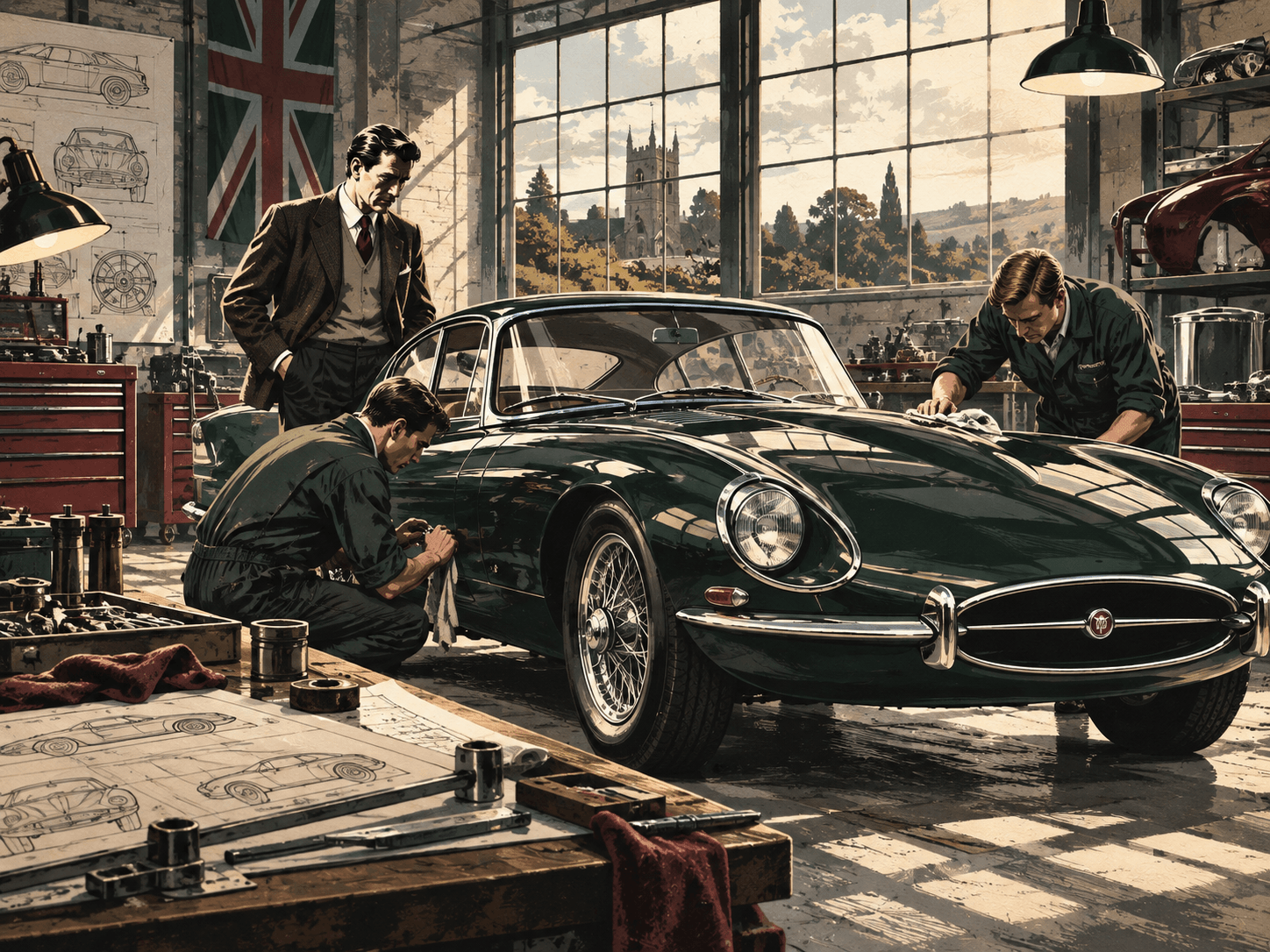
Egan restored more than output. He restored stewardship, quality and confidence.
Egan was not a member of the Lyons family.
Yet his behaviour illustrates something family-business scholars have repeatedly identified: stewardship does not require kinship.
A professional manager can behave like a custodian.
Egan concentrated upon quality, manufacturing discipline, dealers and Jaguar's independence inside the larger organisation. The company recovered sufficiently to be privatised in 1984.
This suggests an important correction to the usual family-business argument.
The useful distinction may not always be between family managers and professional managers.
It may be between stewards and agents.
A steward asks what must be preserved so that the institution remains valuable after he has gone.
An agent can quite rationally ask what will optimise the result for the organisation presently employing him.
Sometimes those produce the same answer.
Sometimes they do not.
Ford made the most rational mistake
Ford acquired Jaguar in 1989.
From Ford's perspective the reasoning was compelling.
Jaguar possessed a globally recognised luxury name but lacked the enormous capital required to compete with BMW and Mercedes-Benz.
Ford possessed capital, engineering resources, purchasing power, factories and global scale.
Combine the two and something wonderful ought to happen.
This is the logic behind thousands of corporate acquisitions.
It is also where the Jaguar story becomes especially useful to family businesses.
The corporation saw Jaguar partly as an underperforming asset.
The founder would probably have seen Jaguar as an idea.
Those are not quite the same thing.
Ford wanted Jaguar to sell more cars.
Again, this was hardly foolish. Developing modern cars costs billions. Greater volume spreads those fixed costs across more vehicles.
The difficulty arose when scale ceased to support Jaguar's identity and began to redefine it.
Nothing demonstrates this better than the X-Type.
When synergy becomes contamination
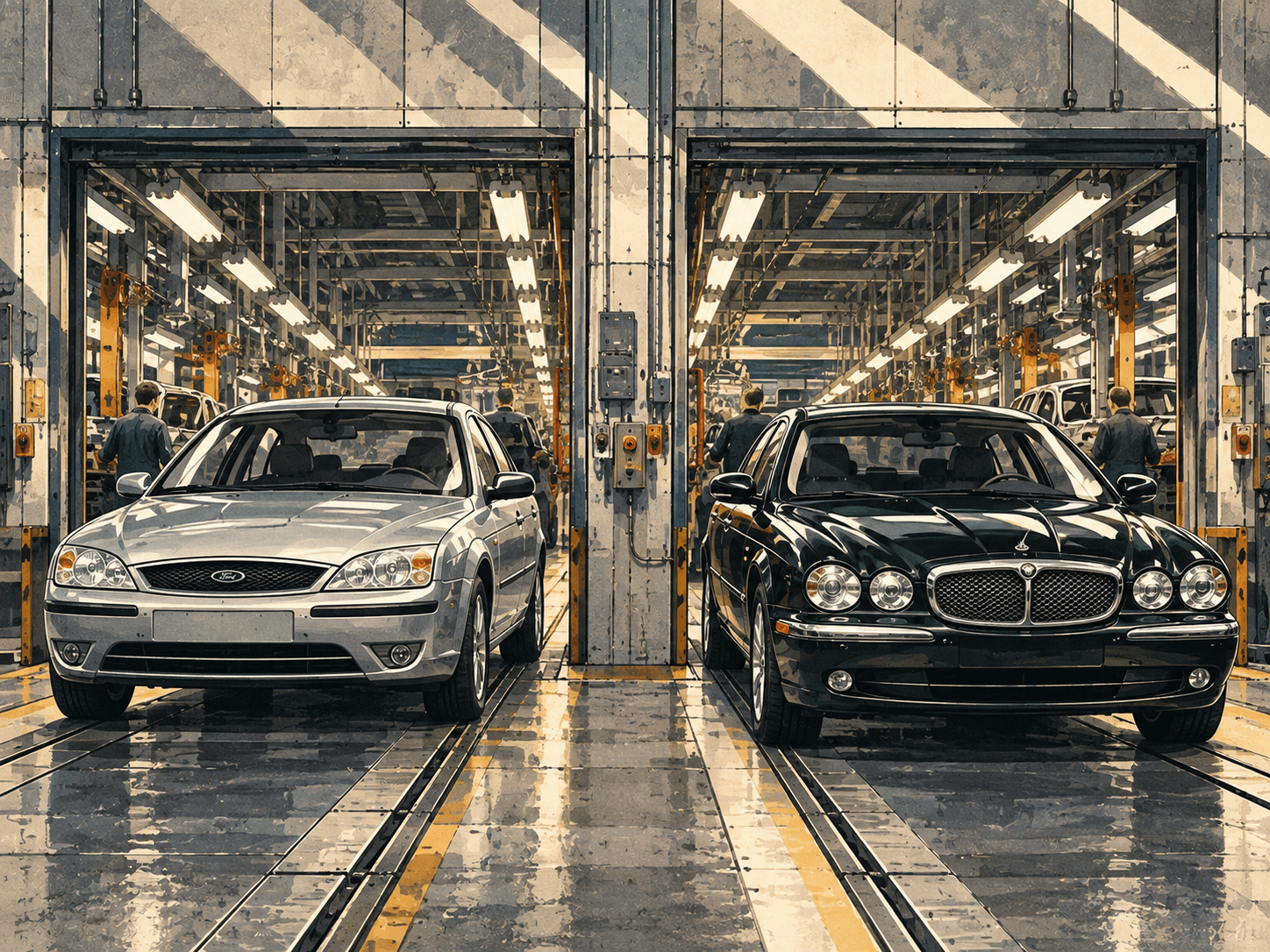
Ford brought scale and logic, but the logic of scale does not always suit a luxury marque.
The X-Type appeared in 2001.
Ford wanted Jaguar to compete in the smaller executive-car market occupied by cars such as the BMW 3 Series and Mercedes-Benz C-Class.
Developing an entirely independent Jaguar platform would have been enormously expensive.
Ford already had one.
The X-Type consequently used a heavily modified version of Ford's CD132 architecture, related to that beneath the Mondeo.
In engineering terms this was sensible.
Indeed, platform sharing has become normal throughout the motor industry.
Psychologically, however, Ford had encountered a different kind of economics.
Luxury depends partly upon distance from the ordinary.
The Mondeo was a perfectly respectable car.
That was precisely the problem.
Once consumers could say that a Jaguar was "a Mondeo underneath", factual accuracy became almost irrelevant.
The association had been created.
For a large manufacturer, shared architecture meant synergy.
For Jaguar, it risked meaning contamination.
Imagine a family restaurant bought by a national chain.
1. The chain discovers that central purchasing can reduce food costs by 12 per cent.
2. The numbers are undeniable.
3. The local butcher disappears.
4. Then the vegetables come from the central supplier.
5. Then desserts arrive frozen.
6. Then menus are standardised because this improves purchasing efficiency.
7. Nothing catastrophic has happened.
8. Nobody made an obviously stupid decision.
Yet six sensible efficiencies later, the restaurant people wanted to acquire no longer exists.
Corporate efficiency can destroy value precisely because it cannot always see the value it is destroying.
This is the danger of "professionalising" a family business
Family-business owners frequently hear that their companies need to become more professional.
Usually they do.
They need financial controls. Proper governance. Succession planning. Management information. Clear responsibilities. Outside expertise.
But professionalisation and corporatisation are not synonyms.
Professionalisation should help a business become a better version of itself.
Corporatisation can gradually make it resemble every other organisation in its category.
Jaguar's experience under Ford illustrates the difference.
The corporation brought resources a small independent Jaguar could never have afforded.
But Ford also brought Ford's problem-solving machinery.
Volume.
Platforms.
Purchasing efficiencies.
Range expansion.
Scale.
These answers were perfectly suited to one of the world's largest motor manufacturers.
They were less obviously suited to a marque whose value depended upon rarity, distinction and an illusion that cost had not dictated every decision.
That is a familiar family-business problem.
Outside managers often arrive with methods that worked brilliantly somewhere else.
The question nobody asks is whether their previous success depended upon being somewhere else.
Jaguar then tried to become German
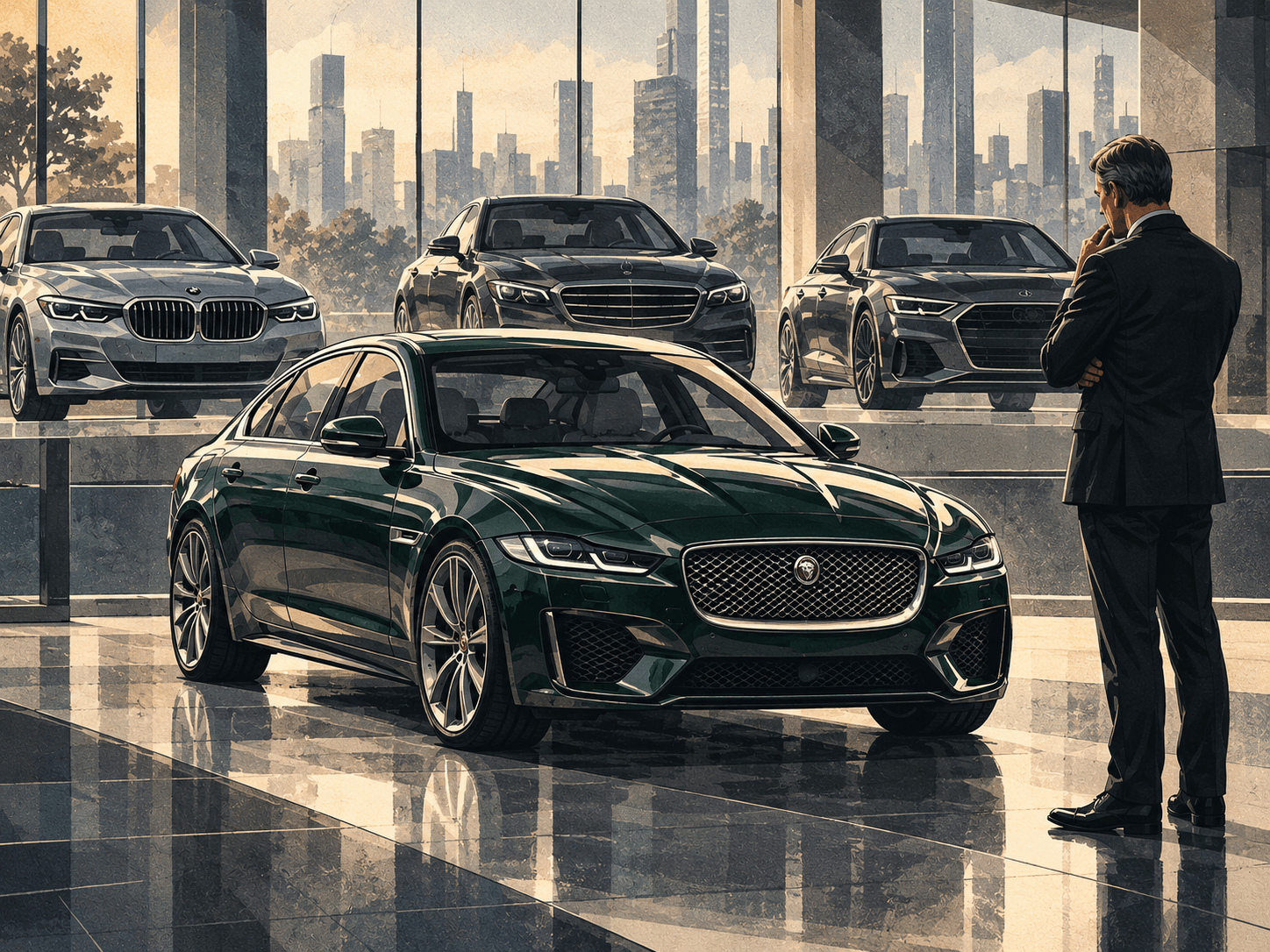
Jaguar built capable modern cars, yet the brand became harder to explain
beside the categories it was trying to enter.
Ford sold Jaguar and Land Rover to Tata Motors in 2008.
Tata deserves a more nuanced assessment than simply becoming the next corporate villain.
It supplied capital and allowed considerable operational independence. Jaguar subsequently created some exceptional cars.
The F-Type captured much of Jaguar's emotional character.
The XE and XF became accomplished sporting saloons.
The I-PACE placed Jaguar remarkably early into the premium electric-car market and won World Car of the Year in 2019.
The engineering problem had not disappeared, but nor was it Jaguar's only problem.
Jaguar increasingly found itself trying to beat German manufacturers according to rules the German manufacturers had established.
Handling.
Technology.
Executive saloons.
Diesel engines.
Fleet markets.
Premium rather than exotic pricing.
The cars became increasingly good.
Yet Jaguar became increasingly difficult to explain.
This is another danger for family firms.
Competitors provide convenient benchmarks.
The successful rival has a larger sales department, so we build one.
It opens more branches, so we open more branches.
Its website looks more contemporary, so ours begins to resemble it.
It uses a particular management system, so we adopt that too.
Gradually the competitor becomes the model.
Eventually the company becomes a less successful version of the organisation it copied.
Jaguar could produce an excellent alternative to a BMW.
The unanswered question was why somebody who wanted a BMW should not simply buy a BMW.
BMW and Porsche provide an interesting contrast
This does not mean family ownership magically solves such problems.
Family businesses can be badly governed, sentimental, nepotistic and spectacularly incompetent.
But two of Jaguar's most important competitors provide an interesting counterpoint.
BMW remains strongly influenced by the Quandt family. At the end of 2025, Stefan Quandt and Susanne Klatten together controlled roughly half its voting rights.
Porsche exists within a far more complicated corporate structure, yet the ordinary voting shares of Porsche SE remain indirectly held exclusively by members of the Porsche and Piëch families.
Neither company should therefore be romanticised as a little family workshop.
They are enormous corporations.
Yet long-term family influence remains embedded in their ownership systems.
That creates an interesting possibility.
Perhaps the importance of family ownership at scale lies less in families personally running factories and more in maintaining a reference point outside the corporation itself.
A professional executive inevitably occupies a temporary position.
The family may still be asking what BMW or Porsche should represent twenty years from now.
That does not guarantee the right answer.
It does mean somebody has reason to keep asking the question.
Jaguar gradually lost that fixed point.
Its owners changed.
Its corporate setting changed.
Its target competitors changed.
Its platform strategy changed.
Its customers changed.
And eventually Jaguar itself became difficult to define.
Reputation is capital too
Traditional accounting handles factories reasonably well.
It handles reputation badly.
A family business may therefore appear irrational when it protects things that never appear clearly on the balance sheet.
The founder refuses to change a supplier.
The family keeps an unnecessarily expensive shopfront.
The chairman personally answers complaints.
The company repairs something outside warranty.
The old recipe remains inefficiently complicated.
An accountant may see costs.
The family may see accumulated trust.
Neither interpretation is necessarily correct.
But both assets and liabilities can exist outside conventional accounting.
Brand researchers describe brands as networks of associations held in consumers' memories (Keller, 1993).
Family-business researchers describe family reputation, identity and continuity as part of the non-financial wealth owners may seek to preserve.
The two ideas meet neatly at Jaguar.
Jaguar's value never consisted simply of factories, patents and distribution.
It also existed inside customers' heads.
• Wood.
• Leather.
• Long bonnets.
• Le Mans.
• Grace.
• Britishness.
• The E-Type.
• A slightly raffish sort of luxury.
Every corporate owner inherited that invisible asset.
Each also modified it.
The paradox of Tata
Tata's ownership provides one further family-business twist.
Tata itself emerged from a business tradition very different from an anonymous publicly owned corporation. The Tata name carries its own history, values and reputation.
Yet large groups still face portfolio economics.
Jaguar Land Rover had two famous British marques but markedly different commercial fortunes.
Land Rover and Range Rover occupied categories in which global demand became extraordinarily strong.
Jaguar remained dependent upon saloons and sports cars for longer and then entered SUVs and EVs into intensely competitive markets.
The consequence was uncomfortable.
Jaguar belonged to a successful automotive group while becoming increasingly difficult to justify within it.
This is analogous to a family owning several businesses.
One division grows rapidly.
Another possesses emotional significance but consumes capital.
At some point affection and economics collide.
Should the family subsidise the historic company?
Sell it?
Close it?
Reinvent it?
The question becomes especially painful when the weakest financial asset carries the strongest family identity.
Why stopping production starts to make sense
This is the context in which Jaguar's extraordinary recent decisions become understandable.
Rather than slowly replace its existing models, Jaguar deliberately allowed the old range to disappear.
Sales consequently collapsed.
But describing that collapse as evidence that the controversial advertising immediately drove customers away confuses cause and effect. JLR had already chosen to wind down the previous range while preparing Jaguar's repositioning.
The company had concluded that competing for conventional premium-car volume no longer worked.
That meant confronting a brutal equation.
High volume with adequate margins can work.
Very low volume with very high margins can work.
Low volume with ordinary margins is much harder.
Jaguar had spent decades in danger of occupying the third position.
So it chose to move upwards.
• Fewer cars.
• Higher prices.
• Greater rarity.
• More distinctive design.
Less direct comparison with BMW and Mercedes.
That is not primarily a change of advertising.
It is a change of business model.
Why the shocking rebrand suddenly looks more logical
Seen from this perspective, Jaguar could not simply produce a prettier logo and continue.
The existing identity itself carried decades of contradictory associations.
Traditional gentleman's express.
Fleet executive car.
Sports-car maker.
BMW alternative.
SUV manufacturer.
Early electric pioneer.
Ford relative.
British heritage marque.
Modern global premium brand.
Jaguar had accumulated too many answers to the question:
What are we?
The radical rebrand attempted to clear the board.
That explains why it felt almost aggressively different.
Jaguar was not merely asking customers to notice a new Jaguar.
It was asking them to abandon their existing mental category for Jaguar.
From a family-business perspective, there is something curious about this.
After decades of corporatisation, Jaguar appears to be trying to behave like a founder again.
It is making a strong, subjective declaration:
This is what we are going to make. Some of you will dislike it.
That sounds remarkably unlike market research.
Sir William Lyons might have recognised the attitude, even if he would have been startled by the pink paint.
What family businesses can learn from Jaguar
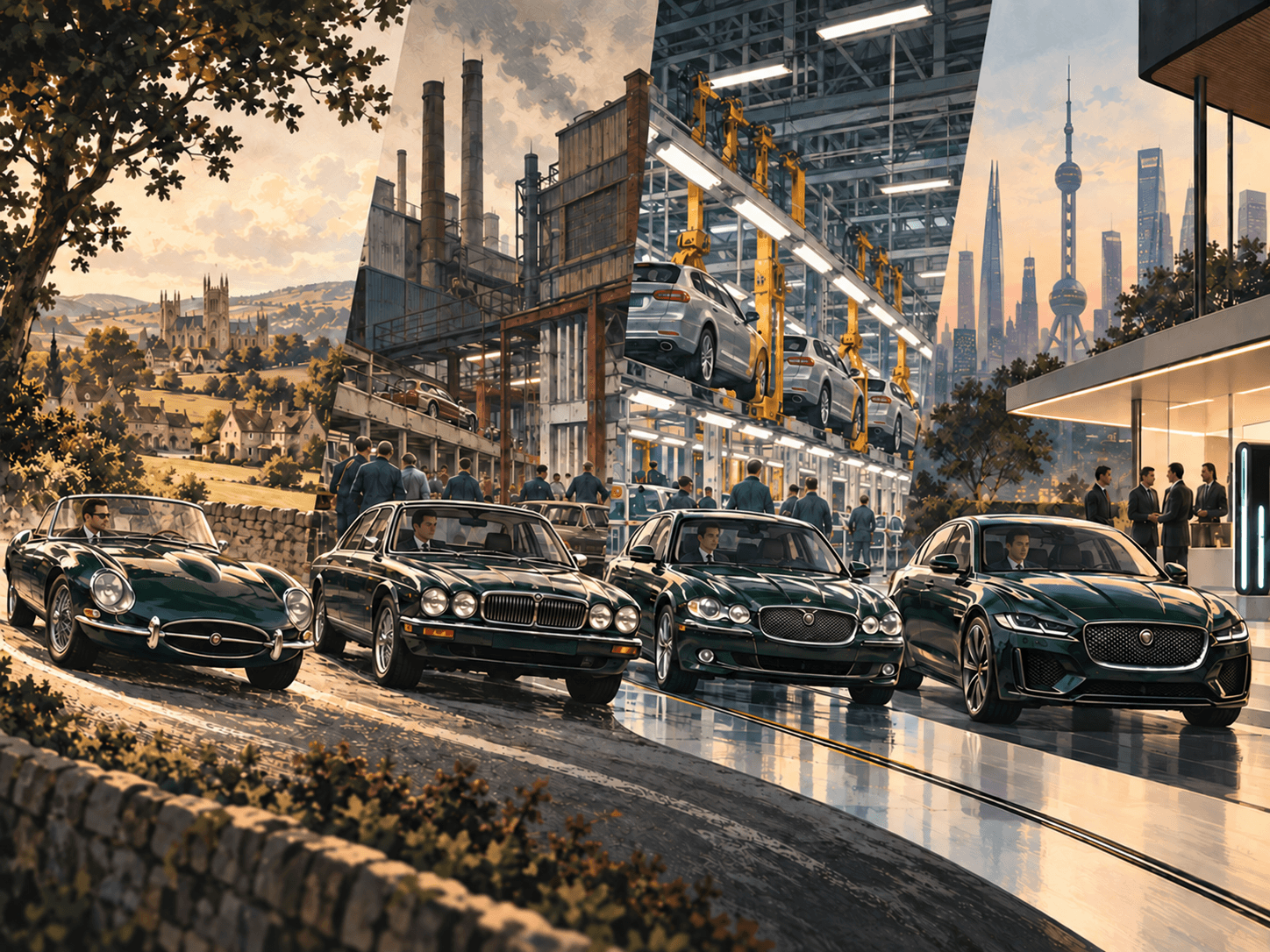
Each new owner brought money, but also a definition of what counted as a sensible Jaguar.
The lesson is not that family ownership is inherently superior to corporate ownership.
History provides far too many disastrous family companies for that.
Nor is the lesson that businesses should refuse outside capital.
Without access to larger resources, Jaguar might have disappeared decades ago.
The lesson is more uncomfortable.
Capital always arrives with a logic attached to it.
When a family sells control, it does not simply exchange shares for money.
It transfers the right to define what counts as sensible.
A corporate parent may sensibly pursue scale.
A private-equity investor may sensibly improve returns.
A professional manager may sensibly benchmark competitors.
A family may sensibly protect reputation.
A founder may sensibly insist upon something everybody else considers absurd.
Every system creates its own definition of rational behaviour.
The danger begins when one system's rationality is applied to a business whose value arose from another.
Economies of scale can become diseconomies of identity
This may be Jaguar's most useful contribution to family-business thinking.
Business schools teach economies of scale.
Buy more cheaply.
Share resources.
Standardise processes.
Spread fixed costs.
Increase utilisation.
All are real.
But distinctive businesses can experience something we might call diseconomies of identity.
As the company becomes bigger and more efficient, the characteristics distinguishing it become increasingly expensive to retain.
The local decision becomes a group policy.
The special component becomes a common component.
The eccentric employee becomes an HR problem.
The longstanding supplier fails procurement criteria.
The owner's intuition fails the investment model.
The irregular product is deleted because its volume is too small.
Each decision improves the corporation.
Collectively they may destroy the brand.
The numbers improve while the reason customers cared quietly disappears.
The succession question is larger than family succession
Family-business literature understandably concentrates upon succession from one generation to another.
Jaguar suggests a broader definition.
Every business must eventually answer:
Who will become the next custodian of the idea?
Sometimes the answer is a daughter.
Sometimes a son.
Sometimes an employee.
Sometimes a professional chief executive.
Sometimes another company.
Ownership succession and stewardship succession are not necessarily the same thing.
A family can retain all its shares yet appoint somebody who misunderstands the company.
A family can sell the company to somebody who protects it magnificently.
What matters is whether the incoming custodian understands which parts of the organisation represent costs and which apparently costly things constitute its value.
John Egan seems to have understood this.
Ford, despite investing enormously in Jaguar, sometimes appeared not to.
That distinction deserves more attention than whether either owner was technically a family.
Jaguar's final paradox
Jaguar therefore arrives at an extraordinary point in its history.
For sixty years, outside ownership repeatedly supplied something the company needed.
Scale.
Capital.
Technology.
Factories.
Distribution.
Purchasing power.
Engineering resources.
Yet each solution also exerted pressure upon the peculiar identity that made Jaguar valuable in the first place.
Now the company is attempting to reverse the process.
It intends to become smaller in volume.
More expensive.
More distinctive.
Less comparable.
Potentially less rational.
In other words, after decades of learning how to behave like a division of a large motor corporation, Jaguar is trying to rediscover the confidence of a founder-led business.
Whether it succeeds remains unknown.
But this makes the controversial rebrand considerably more interesting than an argument about typography or advertising.
Jaguar is conducting an enormous experiment in organisational identity.
It is asking whether a company can recover distinctiveness after decades of corporate rationalisation.
Family businesses face smaller versions of the same question every day.
They employ professional managers.
They accept investment.
They acquire competitors.
They are acquired themselves.
They introduce systems.
They benchmark rivals.
They seek economies.
They prepare succession.
All these things may be necessary.
Jaguar offers one warning worth carrying into every board meeting:
Before making the business more efficient, decide what must remain inefficient enough to keep it special.
Because the most dangerous moment may not come when an outsider destroys the company.
It may come when intelligent people improve it until there is nothing left that anybody particularly wants.
References
Aaker, D. A. (1991) Managing Brand Equity: Capitalizing on the Value of a Brand Name. New York. The Free Press.
Erdem, T. & Swait, J. (1998) “Brand Equity as a Signaling Phenomenon.” Journal of Consumer Psychology, 7(2), 131–157.
Gómez-Mejía, L. R., Haynes, K. T., Núñez-Nickel, M., Jacobson, K. J. L. & Moyano-Fuentes, J. (2007) “Socioemotional Wealth and Business Risks in Family-Controlled Firms: Evidence from Spanish Olive Oil Mills.” Administrative Science Quarterly, 52(1), 106–137. Ithaca, NY. Cornell University.
Jaguar Daimler Heritage Trust (2019) William Lyons: Jaguar's Founder. Coventry. Jaguar Daimler Heritage Trust.
Jaguar Land Rover (2025) Annual Report 2025. Gaydon. Jaguar Land Rover Automotive plc.
Kapferer, J-N. (2015) Kapferer on Luxury: How Luxury Brands Can Grow Yet Remain Rare. London. Kogan Page.
Keller, K. L. (1993) “Conceptualizing, Measuring, and Managing Customer-Based Brand Equity.” Journal of Marketing, 57(1), 1–22.
Le Breton-Miller, I. & Miller, D. (2022) “Family Businesses under COVID-19: Inspiring Models – Sometimes.” Journal of Family Business Strategy, 13(2), 100452. Amsterdam. Elsevier.
Miller, D. & Le Breton-Miller, I. (2005) Managing for the Long Run: Lessons in Competitive Advantage from Great Family Businesses. Boston, MA. Harvard Business School Press.
Miller, D. & Le Breton-Miller, I. (2014) “Deconstructing Socioemotional Wealth.” Entrepreneurship Theory and Practice, 38(4), 713–720.
Miller, D. & Le Breton-Miller, I. (2021) “Family Firms: A Breed of Extremes?” Entrepreneurship Theory and Practice, 45(4), 663–681.
Miller, D., Steier, L. & Le Breton-Miller, I. (2016) “What Can Scholars of Entrepreneurship Learn from Sound Family Businesses?” Entrepreneurship Theory and Practice, 40(3), 445–455.
National Highway Traffic Safety Administration (2024) Safety Recall 24V-927: Jaguar I-PACE High-Voltage Battery. Washington, DC. U.S. Department of Transportation.
Tata Motors (2008) Acquisition of Jaguar and Land Rover. Mumbai. Tata Motors Limited.
World Car Awards (2019) Jaguar I-PACE – 2019 World Car of the Year. New York. World Car Awards.
Stephen Bray doesn’t do hype. He does insight. If your business feels stuck in its own story, you’ll find a different kind of guide here.
© 2025 Stephen Bray. Patterns in life and business, simply told.