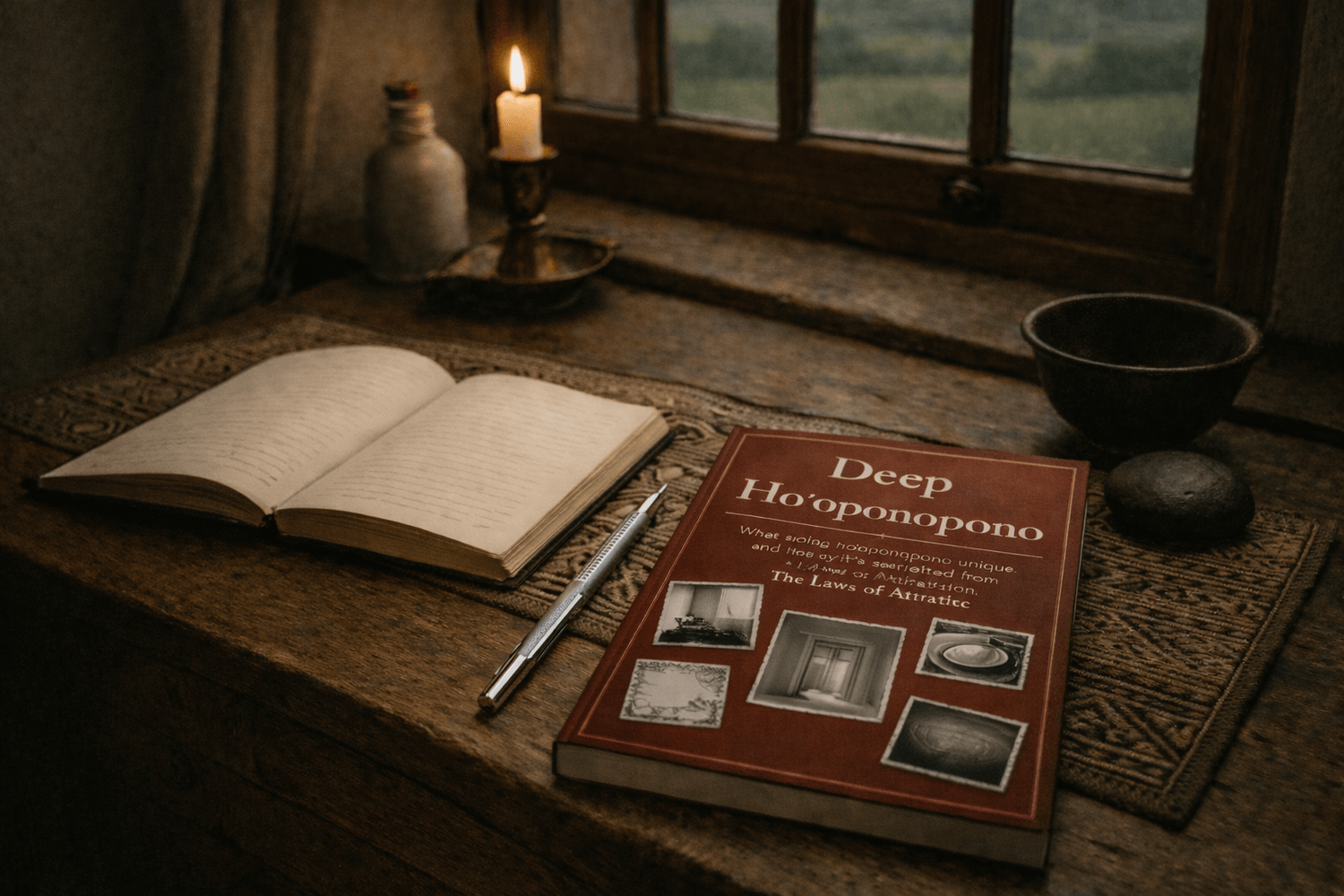
Deep Ho'oponopono{
What makes ho'oponopono unique,
and why it's different from the
Law of Attraction
Deep Ho’oponopono treats ho’oponopono as a return, not a reward system. It speaks to those who arrive exhausted rather than ambitious, and who no longer trust willpower, affirmations, or “high-vibration” effort. This book keeps what endures and lets fashion fall away.
Many modern teachings turn ho’oponopono into a vending machine. Chant for money. Clean for a car. Repeat phrases as if repetition equals wisdom. Deep Ho’oponopono draws a clear boundary. The only “manifestation” that matters here involves a return to Zero, with less unnecessary suffering.
You will not find gimmicks. You will find preparation, timing, and the deeper logic beneath the phrases. The book brings the mirror principle back into focus, not as blame, but as recognition.
If you want a practice that respects mystery, avoids hype, and works on an ordinary Tuesday, this book offers a quiet space. It asks for humility, not belief, and offers a method you can live.
Inside The Book
I'm sorry.
The first phrase, and the one we often avoid
It starts with a whisper.
No chant. No incense. No ritual tone.
Just four syllables.I’m sorry.
In the system taught by Morrnah Simeona, this phrase is directed not at God, not at the universe, and certainly not at some imagined higher version of yourself. It’s not a marketing trick to rebrand guilt as growth.
It is, very simply, what a mother says to her child,when she’s spoken sharply, or misunderstood, or failed to listen.
In Morrnah’s triune model, the Mother is your conscious self. She’s the one who chooses to speak. The Child is your subconscious, the one who carries everything you forgot you felt. Sometimes, you even forgot that you had forgotten it,yet the memory continued to carry power.
The child part of us behaves a little like a toddler. It carries fierce loyalty. It depends on the whole system for safety and survival, so it tries to help in every way it can. It also struggles with negatives. Tell a toddler “don’t fall in that puddle” and you can watch the mind paint a puddle. Say “step onto the dry stones” and the body knows what to do. Say “don’t get your clothes dirty” and the image of dirt arrives. Say “keep your hands clean” and you give the child a clear direction it can follow.
The Apology Is Not Theatrical
“I’m sorry” here isn’t melodrama.
It doesn’t ask for tears.
It doesn’t posture.
It doesn’t seek to impress a spiritual audience.
It’s a natural movement of repair.
A realignment of love with truth.
Not sacred, not profane — just real.
It’s simply that you’ve forgotten to treat your subconscious as an infant. You must make amends before adding to the confusion.And almost everyone who has ever cared for a child knows this moment:
You acted out of frustration.
Or fear.
Or tiredness.
And you hurt someone small.
Later, when your own defences dropped, you went to them.
And you said:
“I’m sorry, darling. I didn’t mean to snap. I got it wrong. That wasn’t fair.”
No grandeur. No ceremony.
Just a hand on the shoulder. Just warmth.
Just a return to being safe.
The system naturally seeks equilibrium, like wind moving from high pressure to low pressure. Overvaluation produces counter-pressure. That counter-pressure can show up as delays, obstacles, or reversals, not as punishment, but as a restoring movement.
The obstacle does not sit inside the dream itself.
You Don’t Need to Know What You’re Sorry ForThis confuses many.
“How can I say sorry if I don’t know what I did?”
Because in this model, the conscious mind doesn’t always see the injury.
It only feels the weight.
You don’t need to track the origin of the pain.
You don’t need to name the karma.
You don’t need to understand the trauma.
You only need to acknowledge:
Somewhere in me, something hurts.
And I’ve ignored it.
Or judged it.
Or tried to rise above it.
And for that
I’m sorry.
When someone forces outcomes through resistance, they can obtain the object and still feel miserable.
When someone cultivates the inner first, outer rewards become an addition rather than a rescue.
Good enough can keep you stable. It rarely keeps you alive.Your best future often sits outside your current menu of options. You won’t find it by selecting the least frightening path in front of you.
You find it by deciding to look beyond the menu.
Fear whispers that disappointment hurts too much, so you should avoid wanting anything large.
That logic protects you from short-term pain and steals long-term life.
The biggest risk does not come from choosing the wrong door.
The biggest risk comes from never choosing.Trust and a paper trailWhen you’re sorry, trust matters.
Trust does not mean blind optimism. Trust means you stop demanding certainty before you move. You remind yourself that ho’oponopono can use your imperfect steps. You remind yourself that even a mistake can teach, redirect, and strengthen.
Your mind forgets. Your emotions wobble. Your environment pushes you back into old defaults. A written decision becomes a stake in the ground. It becomes something you can return to on tired days, especially before ho’oponopono becomes a way of life.
Say ‘I’m sorry’. Say it once.
Say it quietly. Say it without expecting anything in return.
You’re not talking to the heavens. You’re not asking for permission to grow. You’re simply acknowledging that you forgot to tend to something that matters.
That something is the inner bond.
Between the chooser and the carrier. Between the voice and the silence. Between the self that moves and the self that remembers.
What Happens Next? Maybe nothing. Maybe a wave of sadness. Maybe a flicker of peace. Maybe a memory, long buried, surfaces.
Or maybe the only shift is this: You’ve stopped abandoning yourself.
And that, in ho‘oponopono, is the beginning of everything.
Why I Wrote This Book
Like the first book, I wrote this because both the simplified, popular take on ho‘oponopono and its strict, “only for Hawaiians” counterpart felt like half-stories.
When Morrnah Nalamaku Simeona shared the method beyond Hawaii, people shaped it through their own cultures. In the West, it often got framed as a way to “get things.” You might see some gains, you might not, but that’s not the real point.
Same with asking others to chant for you. The real work happens in your own field. You chant for yourself.
Ho‘oponopono isn’t the only way to heal. But it offers a clear lens for tuning your own inner pattern so the rest of life can respond in kind. Like adjusting a string until it stops buzzing, the change starts small, but you feel it ripple out.
You may never understand life in the same way again!
As an Amazon Associate I earn from qualifying purchases.